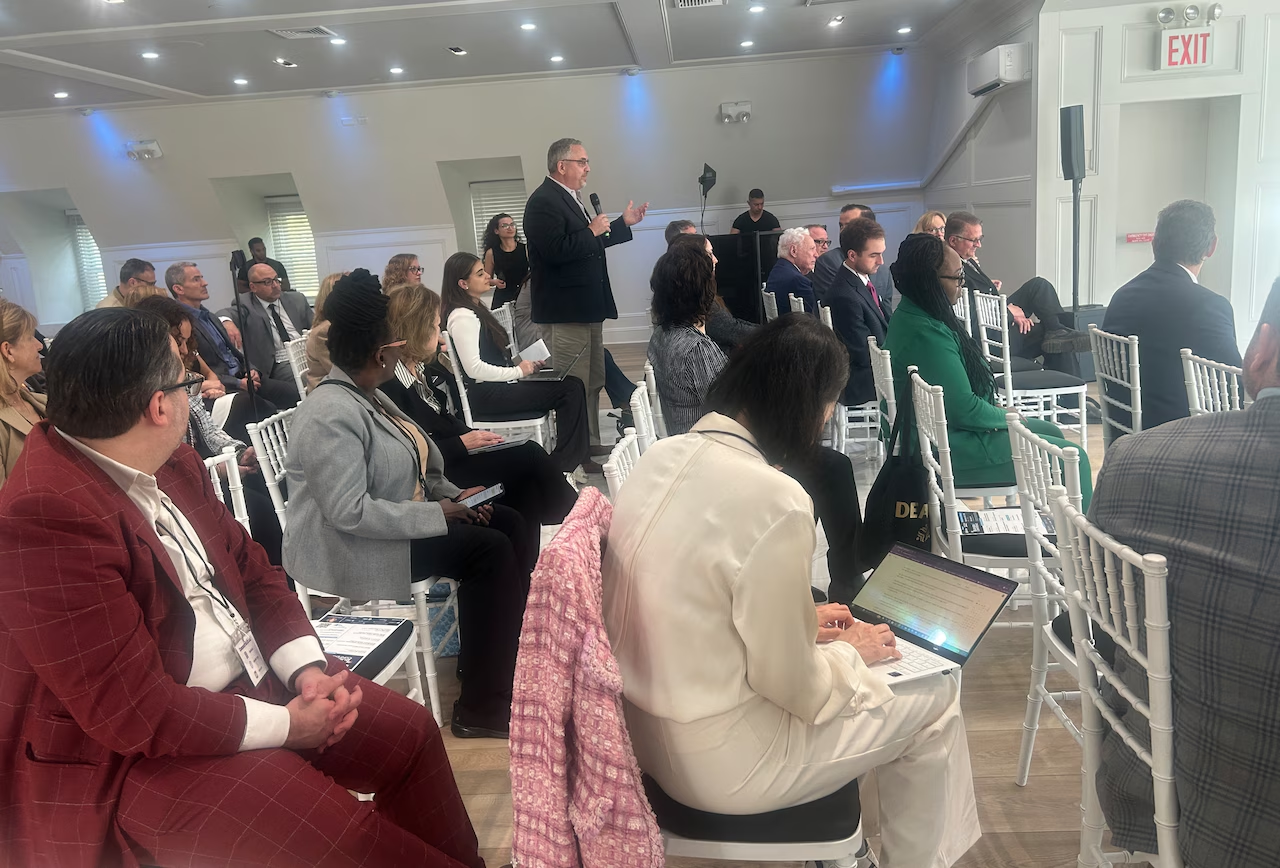
STATEN ISLAND, NY – The Staten Island Economic Development Corporation held a public discussion at the Grand Oaks Country Club on the US economy and its impact on Staten Island, with an official from the Federal Reserve Bank of New York.
The conference, chaired by SIEDC President, Michael Cusick, brought together business leaders, financial advisors and civil servants to examine economic trends, with discussions focusing on inflation, interest rates and the growing role of artificial intelligence.
Cusick opened the meeting by thanking the attendees before introducing John Williams, president of the Federal Reserve Bank of New York and vice chairman of the Government’s Open Market Committee.
Economic theory from Williams
Williams spoke about the current state of the US economy, saying it is still in “good shape” despite the uncertainty surrounding trade and other policies.
He noted that growth has remained stable from last year until early 2026, with steady spending and business investment remaining strong.
Williams emphasized the dual mandate of the Federal Reserve, which aims to achieve high levels of employment and price stability.
On the labor side, he noted that important indicators show “mixed signs”, with the unemployment rate stable between 4.3% and 4.5% since last July and the growth of wages and job opportunities showing significant changes.
On the price stability side, Williams said inflation is currently close to 3%, with tariffs contributing between “half and a quarter” of a percentage point.
He also noted that the recent increase in energy prices could increase overall inflation in the coming months, but he expects these effects to moderate later this year if conditions in the Middle East stabilize.
“My opinion is that there is a lot of uncertainty, but we have seen that the economy is more stable than expected,” he said, emphasizing the country’s continued leadership and dedication in technology and other industries.
Williams stressed that long-term economic growth depends on investment in business capital, technology and people.
He also noted that preparing workers for the future requires adopting technology that improves productivity and creating links between private organizations, non-profit organizations and educational institutions.
“It’s about putting all the pieces together,” he said.
Williams also highlighted Staten Island’s resilience, pointing out how quickly the borough has recovered from the coronavirus (COVID-19) pandemic.
He spoke about the area’s problems, such as transportation and traffic patterns, housing affordability and preparing people for jobs that may involve artificial intelligence.
After Williams’ remarks, the show went into a question-and-answer session with the audience.
Questions from attendees
Cusick began with a question about the challenges and opportunities Staten Island currently faces.
Williams said the district’s challenges include transportation and housing affordability, saying building more homes and improving infrastructure is only part of the solution.
He pointed out that the Federal Reserve is focused on community development and bringing stakeholders together to create impactful solutions.
“It’s about thinking holistically about how you create a healthy community,” Williams said. It’s jobs, housing, transportation, other essentials—all those things go together.
Williams also noted that although artificial intelligence can be seen as a challenge for some citizens, it can also be seen as an opportunity to create new jobs in the future and make workers more productive in many types of industries, not just technology-based jobs.
Jonathan Peters, a finance professor at the College of Staten Island (CUNY), asked about efforts to drive economic development and infrastructure investment in southern Manhattan.
Williams said the Federal Reserve is focused on long-term solutions that promote opportunity across regions and emphasized the importance of public-private partnerships to support growth.
He highlighted how the Federal Reserve collects data across the entire region—including New York City, New York, Puerto Rico and the US Virgin Islands—and can provide granular, local analysis to inform policy and progress.
Williams noted that the Federal Reserve is willing to work with local leaders and include additional information, which could help guide decisions affecting Staten Island and other parts of the state.
Chris Barrera, CEO of the technology company, asked how the downsizing of many publicly traded companies powered by AI could affect small businesses and how education and employee preparation should respond.
Williams said the exact results are uncertain but pointed out that technology-driven change is not new, noting examples throughout US history such as the steam engine, electrification and tractors on American farms. He acknowledged that AI can replace some jobs but can also serve as an important tool to make employees more productive.
“Increased productivity; the ability to earn twice as much in other things, really makes workers more productive,” Williams said.
He also said that preparing young people to work effectively with AI and developing the right skills is important. Williams also noted that entrepreneurs and business growth play an important role in creating new jobs.
He said: “Some types of jobs can be replaced by technology, but many more will be created because people now have the tools that make it more efficient.
After the Q & A, the discussion turned into a networking session, giving attendees the opportunity to connect with business leaders, financial experts and public officials.
#Federal #Reserve #official #Staten #Island #facing #significant #economic #challenges