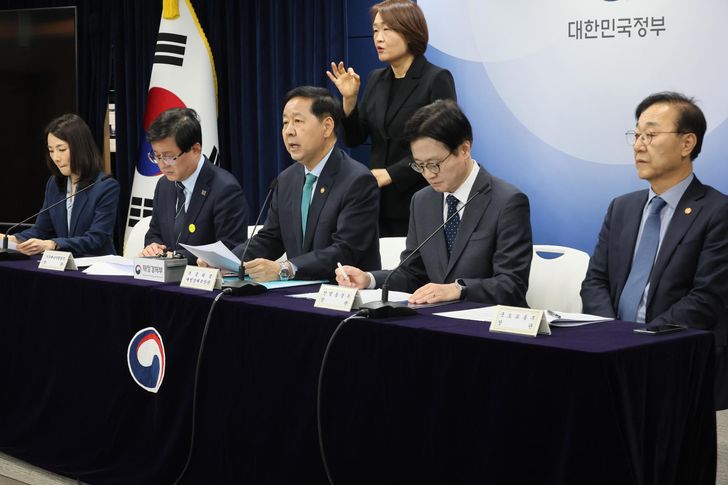
Finance Minister Koo Yun-cheol, center, speaks during a joint meeting of relevant ministries on emergency economic response measures to the Middle East conflict at the Government Complex in Seoul, Thursday. Yonhap
The Korean government may extend its five-day mandatory ban on vehicle operations to include private vehicles if global oil prices rise above $120 a barrel, Finance Minister Koo Yun-cheol said Sunday.
Appearing on KBS’s current affairs program, Koo said the government may need to raise the country’s resource crisis alert to Level 3 if the situation worsens, adding that expanding restrictions on the private sector may be necessary to gain wider cooperation.
“If the crisis rises to Level 3, oil prices may rise even more, which makes the restriction of demand inevitable,” he said, adding that although the participation of private vehicles is currently voluntary, this step may become mandatory if the situation worsens.
Under the five-day rotating ban, vehicles are restricted from operating one day each week based on the last number of their license plates – ending in 1 and 6 on Monday, 2 and 7 on Tuesday, 3 and 8 on Wednesday, 4 and 9 on Thursday and 5 and 0 on Friday, with no restrictions on weekends.
As part of efforts to resolve the energy supply crisis caused by the US-Iran war, the government has ordered public passenger vehicles to comply with the law since last Wednesday. Electric and hydrogen vehicles, vehicles used by people with disabilities and carrying pregnant women or infants are exempt.
Major financial institutions such as KB Financial Group and conglomerates including Hyundai Motor Group have also voluntarily joined.
Korea has four levels of resource security problems. The government activated Level 2, or “Caution,” at 3 pm on March 18 amid concerns about a possible disruption to crude oil supplies.
Koo said any decision to raise the alert level would be based on a full assessment of the overall situation.
“Although the price of oil is still changing between $100 and $110 per barrel, the authorities will measure the situation if they enter $120-$130,” he said.
There is historical precedent for restricting the use of private vehicles to curb energy consumption.
During the oil boom of the 1970s, the authorities banned the operation of luxury cars with eight or more cylinders. After the Gulf War of 1990, which raised the price of oil, a 10-day driving rotation system was implemented for about two months in 1991. During the Asian financial crisis in the late 1990s, an unusual driving system based on license plate numbers was considered but ultimately not implemented.
Separately, the Seoul Metropolitan Government has its own two-day circulation system with the public sector as part of emergency measures to reduce dust, using government and public sector vehicles as well as staff vehicles. The latest such measures were implemented on March 17 this year.
In relation to the plans of the central government, the Ministry of Economy and Finance has emphasized that certain values or causes affecting autonomous vehicles have not been finalized.
“The possible use of the project of circulation of cars in private vehicles can be considered only if the level of crisis can be raised, based on a comprehensive analysis of factors including oil prices, general electricity supply conditions and the impact on people’s daily lives,” the ministry official said. “Minister Koo cited oil prices as one of several indicators of the severity of the situation, and his words were intended to encourage the public to join efforts to curb energy use.”
Meanwhile, regarding the additional budget of 25 trillion won ($16.5 billion) being prepared to reduce the economic fallout from the conflict in the Middle East, Koo said that the spending will focus on four important areas – responding to the high price of oil, supporting livelihoods, helping key industries and stabilizing supply chains.
He said: “This package will be fully funded by higher tax revenues than expected and will not depend on issuing new debt.”
Addressing the recent increase in the exchange rate of more than 1,500 won to one dollar, Koo downplayed concerns, citing the country’s strong position, including more than $420 billion in foreign reserves and foreign assets of about $900 billion. He said the situation is “not a cause for panic.”
He also noted that Korean government bonds will be included in the World Government Bond Index (WGBI) starting next month, while the government is pursuing entry into the Morgan Stanley Capital International developed market index.
He expressed expectations that the incorporation of WGBI could attract about $50 billion to $60 billion in foreign investment, helping to support the local economy.
#Finance #chief #hints #rolling #ban #private #cars #oil #hits #Korea #Times